

Are Flask Templates Django Templates
Whether you're a new developer or a seasoned professional person looking for a new Python web framework, Django and Flask offering two compelling open source options to choose from. So, how do you choose which framework is best for you lot? This article is designed to make that decision easier by providing an in-depth comparison of the two frameworks.
Django is a comprehensive framework for edifice large and dynamic web applications. It has a built-in database (ORM) and a variety of pre-built features to cull from. Though it can sometimes be complicated to get started with, Django is a good choice for rapid evolution and complex applications.
Alternatively, Flask is a lightweight microframework for elementary website building. It lacks a congenital-in database but offers the ability to add other plugins for complete control and customization. Information technology'due south well-suited for those who like to build from scratch and swoop deeper into the specifics.
Django is the framework of choice at companies like Google, YouTube, Instagram, Pinterest, NASA, Spotify, and Dropbox. Flask, meanwhile, is used at Airbnb, Netflix, Samsung, and RedHat.
The Major Differences between Flask and Django
Before diving into comparison some modest sample applications for each framework, permit'due south briefly go over the major features of Django and Flask.
Central Features in Django
Django uses a Model-Template-View pattern and its packages are reusable apps, websites, tools, and other resources. It'southward richly featured out of the box and supports functionality for user authentication, content administration, site mapping, RSS feeds, and other web development tasks. It'south also SEO-optimized, as sites are maintained using URLs. Additionally, it's highly secure, providing XSS protection, CSRF protection, SQL injection protection, clickjacking prevention, SSL/HTTPS, host header validation, and other security policies.
Django is more suited for complex applications than Flask, and as such is a more than complex framework. Django has a steep learning curve, but its versatility makes it very popular. It's used for everything from CMS and social networking platforms to scientific computing platforms.
Fundamental Features in Flask
Flask is a microframework that'southward unproblematic simply extensible. It offers integrated unit testing, using the Jinja templating engine and Werkzeug WSGI toolkit. Flask supports secure cookies and has templating, routing, error handling, and a debugger. The framework focuses on initial ease of deployment but allows a huge range of Python plugins and libraries to accommodate deep flexibility and customization.
Sample Code Comparing
Let'due south compare how uncomplicated information technology is to create a basic app using Django and Flask. This app will accept a username as the input and and then display a message on the screen.
Django Sample Project
First, create a project directory. And so create a folder within it chosen venv.
On a Windows machine, apply the post-obit commands:
> mkdir djangoproject > cd djangoproject > py -3 -m venv venv On a MacOS/Linux machine, use the following commands:
$ mkdir djangoproject $ cd djangoproject $ python3 -m venv venv Then, actuate the environment.
On Windows:
> venv\Scripts\actuate On MacOS/Linux:
$ . venv/bin/activate Upgrade pip by using the following command:
python -thousand pip install --upgrade pip And so, install Django.
python -m pip install django To set up and kickoff the Django project, use the following command:
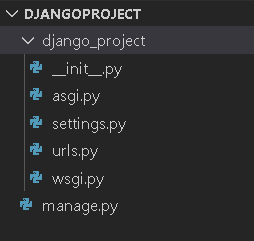
django-admin startproject django_project Django projects are made up of many site-level configuration files, too as 1 or more than "apps" that you publish to a web host to class a completely online application. Y'all'll create your app later down beneath.
At this bespeak, the project directory structure should await like this:
Adjacent, create an empty evolution database:
python manage.py migrate Run the database to verify that everything works correctly.
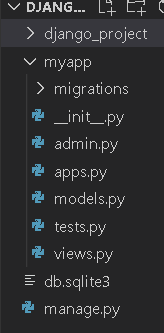
python manage.py runserver Now, create a Django app called myapp with the following command:
python manage.py startapp myapp Your directory construction should look like this:
There are a few adjustments to brand before you tin go started.
Get-go, add your app name to INSTALLED_APPS in /django_project/settings.py.
INSTALLED_APPS = [ .. 'myapp', ] Django uses templates as an piece of cake way to generate HTML dynamically. Templates include both static and dynamic content components, as well as a specific syntax for inserting dynamic data. To apply templates, make the following changes to DIRS within TEMPLATES in the aforementioned file:
import bone TEMPLATES = [ { 'BACKEND': 'django.template.backends.django.DjangoTemplates', 'DIRS': [bone.path.join(BASE_DIR, 'template')], ..}] The URL dispatcher uses a path to route URLs to the proper view functions inside a Django application. In django_project/urls.py, add the path for myapp project to urlpatterns with the post-obit code:
from django.contrib import admin from django.urls import include, path urlpatterns = [ path('', include("myapp.urls")), path('admin/', admin.site.urls), ] Add the paths for the abode and welcome views to myapp/urls.py:
from django.urls import path from myapp import views urlpatterns = [ path("", views.home, proper noun="home"), path("welcome", views.welcome, name="welcome") ] Then, add the following code to myapp/views.py:
from django.shortcuts import render, HttpResponse # Create your views here. def abode(asking): render render(asking, 'alphabetize.html') def welcome(request): username = request.GET["name"] render render(request, 'welcome.html', { 'name': username}) This code defines dwelling to return the alphabetize.html template and defines welcome to become user input and render welcome.html to evidence the effect bulletin.
Side by side, create your index.html file and add the following code for the Welcome page to accept user input:
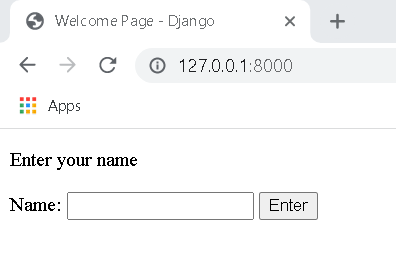
<!doctype html> <html> <title>Welcome Page - Django</title> <body> <p> Enter your name</p> <course action = "welcome"> Proper noun: <input type = "text" name="proper noun"> <button type="submit">Enter</push> </grade> </body> </html> Then, create a welcome.html file to brandish the event:
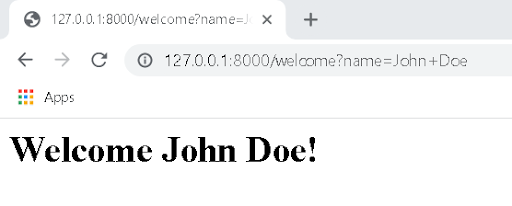
Welcome {{proper name}}!
Run the projection.
python manage.py runserver And so, open a browser to http://127.0.0.1:8000/. You should run into a page that renders a prompt to enter your name that looks similar to this:
Entering your name and clicking the Enter push button should give you the following output:
Flask Sample Project
Now that you understand the basics, allow'south turn our attention to a sample project.
Outset, create a projection directory. Then, either use the virtual environment from the Django sample, or create a new ane. Next, activate the environment and install Flask using the post-obit command:
pip install flask Create a new Python file called app.py.
In app.py, add the following code to import Flask and to create a route for the home and welcome pages:
from flask import Flask, redirect, url_for, render_template, asking app = Flask(__name__) @app.route("/") def home(): render render_template ("alphabetize.html") @app.route("/welcome", methods=["Postal service", "Get"]) def welcome(): if request.method == "Mail": name = request.form["name"] return f" Welcome {proper noun}!
" else: return render_template ("index.html") if __name__ == "__main__": app.run(debug=True) This code defines home to return alphabetize.html, and welcome to become user input from the form and display it on welcome.html.
In the aforementioned directory as app.py, create a folder called templates. In information technology, create an index.html file and add the following code to accept user input via form:
<!doctype html> <html> <title>Welcome Page</championship> <body> <p> Enter your name </p> <form action="#" method="post"> <p>Proper noun:</p> <p><input type="text" name="name" /></p> <p><input type="submit" value="Enter"/></p> </class> </torso> </html> Run the project.
python -m flask run Then, open a browser to http://127.0.0.ane:5000/welcome. You should see a page that looks similar to the ane rendered past our Django project:
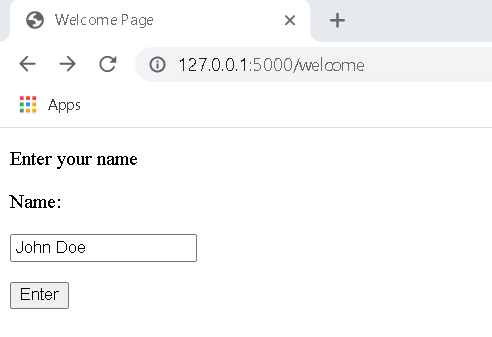
Inbound your proper name should give you the post-obit output:
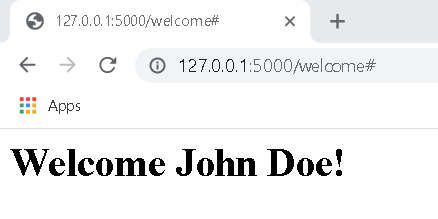
Our sample projects make 1 thing evident: Flask is relatively straightforward to set upwards and get started, just Django needs a few more steps because it's designed for large projects with more than varied capabilities.
Fundamental Differences for Developers
Let's examine and compare Django against Flask based on some major factors affecting developers working in the frameworks. In this section, nosotros'll go over each framework'due south tech stack, ease of development and startup complexity, their overall capabilities, functioning, supporting libraries and integrations, and finally their level of documentation and community support.
Tech Stack
Architecture
Django has a variation on the archetype MVC design known as MVT (Model View Template) where the standard Controller is chosen the "View," and the View is chosen the "Template."
Flask is more open-ended, lacking a gear up compages. It can brand utilise of extensions and other configurable options and is sometimes referred to as having a DIY compages.
Templates
Django has back ends for its own template system, dubbed the Django template linguistic communication (DTL). For example:
- Variables: My first proper name is
{{ first_name }}. My last proper name is{{ last_name }} - Tags taking arguments:
{% cycle 'odd' 'fifty-fifty' %}
Flask uses the Jinja template library to return templates. It utilizes files containing both static information and placeholders for dynamic data. For example:
- Variables:
{{ foo.bar }}or{{ foo['bar'] }} - To employ Python commands:
{% if loop.index is divisibleby 3 %} -
{% if loop.alphabetize is divisibleby iii %}Python commands
Data Modeling
Django includes its own built-in object relational mapper (ORM) that may exist used for data manipulation, querying, filtering, selection, and other standard operations.
Flask doesn't have its own database, but it connects to other Python modules in the Python bundle index, such equally SQL Alchemy and MongoEngine.
Ease of Development and Overall Startup Complexity
After installation and project setup, Django has congenital-in files and configurations. This requires more than work from the programmer to get started.
Flask is easier to install and use because you can use but a unmarried command to get started. The post-obit image illustrates the steps involved in setting up a simple Hello Globe program betwixt Django and Flask:
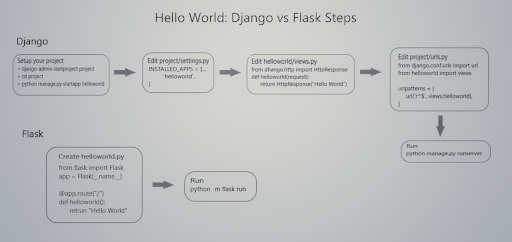
Flask requires only a uncomplicated installation followed by the cosmos of an app.py file to get started. Django, on the other hand, requires you to initiate the Django project first and then build your app and configure other modifications. Django requires all of this to manage the large projects it's intended to be used for.
Overall Capabilities
Beginners often notice Django a lilliputian intimidating to get started with; many find Flask to be an like shooting fish in a barrel alternative. But, although Flask can be used for multiple pages and big projects, it is non an ideal pick for circuitous projects with databases.
Users and Admin
Many websites demand user accounts managed past an admin interface. Django has a built-in user and admin framework that is easy to employ. Flask, on the other hand, requires multiple extensions to accomplish this functionality merely offers extensions like Flask-Security that bring it up to the same level of ease every bit Django. Comparing the frameworks in this expanse comes downwardly to ease of use versus customization.
Django users tin use the built-in django.contrib.auth user model. Administration is a highly customizable permission system, and information technology's also easy to use.
Flask doesn't have congenital-in users but can use the pop Flask-Login extension to attain the same effect. Administration in Flask uses Flask-Admin, is highly customizable, and tin work with SQLAlchamy, MongoEngine, and others.
For argument'southward sake, permit's say everyone is using the same set of extensions for projects like flask-admin to create an admin panel. In such a scenario, y'all open possibilities for security problems with Flask. This is considering y'all tin't customize it to your needs. You tin can, however, use Flask-Security to aid take care of these concerns.
Apps in Django vs Blueprints in Flask
Django developers utilize apps, whereas Flask developers apply blueprints to create components. They both serve the same role of splitting the code into independent modules to provide reusability. Django apps are more all-encompassing and numerous, but they're also more difficult to work with. Flask blueprints are simpler and easier to integrate into a project.
API Comparison
APIs are becoming more widespread for web applications, and they frequently demand unlike patterns than HTML web pages.
The Django REST framework includes multi-layered abstraction, hallmark controls, serializers, and extensive documentation. Information technology's important to annotation that the Django web framework only works easily with relational databases.
Flask offers multiple extensions that work together with the Marshmallow framework-doubter library. Then, it can provide more flexibility than Django. But you have to configure it yourself.
Performance
Flask is faster than Django, although the divergence might be too small to notice in many cases. By being a lightweight framework implemented mostly on minor projects, it has better operation than large frameworks like Django. Choosing which framework to apply by and large depends on your project size and requirements.
Supporting Libraries/Plugins and Extensions
Both Django and Flask provide the ability to integrate with other libraries or extensions to raise their performance. Let'southward look at some examples.
For Flask:
- Flask-AppBuilder is a web application generator that utilizes Flask to generate code for database-driven applications depending on user-specified parameters.
- Flask-Qualify is a Flask plugin that makes it easier to implement access control lists (ACLs) and part-based admission control (RBAC) in web applications.
- Flask DebugToolbar is a Flask port of the well-known Django Debug Toolbar project.
- Flask RESTX is a Python extension for easily including RESTful APIs in your applications.
For Django:
- Django Extensions includes shell_plus, which volition automatically import all models in your project. It includes several of import commands, such as
admin_generator,RunServerPlus, andvalidate_templates. - Django-allauth provides hallmark, registration, and business relationship direction solutions.
- Django Compressor consolidates all of your JS and CSS files into a single cached file. It likewise has Jinja templating and ReactJS support.
- The Celery application, which handles long-running, data-intensive tasks that tin can't be handled in the request-response cycle, at present supports Django out of the box.
Customs Support and Documentation
Django's full documentation, with its uncommonly detailed guides and tutorials, is more thorough than Flask'southward. Django likewise has a larger community, and therefore, more than back up. Django GitHub has 63.1k stars, whereas Flask has 58.4k stars (equally of March 2022). This illustrates that more people have shown involvement in Django than Flask based on their projection requirements. Additionally, Stackoverflow currently has over 285,000 questions tagged [django], simply only but over 49,000 questions tagged [flask].
Side-by-Side Comparison
Both Django and Flask are well suited for their specific, differing roles. Permit'due south briefly examine the strengths and weaknesses of both frameworks once again.
Pros and Cons of Django
Pros:
- Django is unproblematic to install and utilise with many in-built features.
- It has an easy-to-use interface for administrative tasks.
- You can employ Django for stop-to-cease application testing.
- The REST Framework provides extensive back up for a diversity of authentication mechanisms.
- Information technology ensures speedy evolution with a robust congenital-in template design.
- Django'southward caching framework includes a broad variety of enshroud techniques.
- It has a comprehensive set of tools.
- Django'south large community offers cracking support and documentation.
Cons:
- Django's monolithic way can make things too difficult and concepts as well stock-still.
- Prior agreement of the framework is needed to accomplish many things.
- For a simple project, there are besides many functions in Django'south high-end framework.
- URL dispatching using controller regex complicates the codebase, which is heavily reliant on Django ORM.
- Django has less flexible design considerations and fewer components.
- Information technology has a steep learning curve.
- Its WSGI service can handle only one request.
- You lot'll demand some familiarity with regex for routing.
- Internal subcomponents are tightly coupled.
- Components tin can be deployed together. This might atomic number 82 to confusion betwixt developers if, for example, you create and use also many template components.
Pros and Cons of Flask
Pros:
- As an independent framework, it allows for architectural and library innovation.
- Flask works well for modest projects.
- It ensures scalability for simple applications.
- It's easy to quickly create prototypes.
- Routing URL functions using the Werkzeug WSGI library is simple.
- Awarding development and maintenance are painless.
- Flask is adaptable and well-suited for emerging technologies.
Cons:
- In about circumstances, the time to Minimum Viable Product (MVP) is slower.
- It has an inadequate database and ORM options out of the box.
- Flask is not appropriate for big applications or projects.
- Information technology lacks built-in admin functionality for managing models and for inserting, updating, or deleting records.
- Complicated systems take higher maintenance expenses.
- Maintenance is more than difficult for bigger deployments.
- Flask suffers from a smaller community, hampering support and slowing its growth.
- The framework is non standardized, and then the programmer of i project might not easily empathize another project.
- There are fewer tools available, so developers often demand to build tools from scratch, which is time-consuming.
Terminal Thoughts on Choosing Flask vs. Django
Choosing which framework to work with is entirely up to you, and will depend on the size and telescopic of your project. Equally you saw throughout this article, Flask is meliorate suited for basic, single-page spider web apps with minimal or no database requirements, though it may produce loftier-performance spider web apps if you lot're careful to keep them small. Flask's ability to apply Python extensions and libraries provides versatility, but it likewise introduces extra work into the process. The platform is best suited for developers who want to build things from the footing up and dive deeper into the specifications.
Django is an splendid solution for more highly complicated spider web apps that rely on databases. Considering of its many specifications out of the box, it'south simple for someone with no web programming experience to get started and construct an app using born templates and Django's other features. It also enjoys an active community that provides thorough back up and documentation.
This article has highlighted the differences between Django and Flask and should help you decide which of these frameworks will best benefit the development of your next app. Looking to learn more? To dive deeper and find other articles similar this ane, check out Mattermost and visit the Mattermost Blog.
This weblog post was created as role of the Mattermost Customs Writing Program and is published under the CC Past-NC-SA four.0 license . To learn more than about the Mattermost Customs Writing Program, bank check this out .

Are Flask Templates Django Templates,
Source: https://mattermost.com/blog/flask-versus-django-which-python-framework-is-right-for-you/
Posted by: harveyterfew1943.blogspot.com
0 Response to "Are Flask Templates Django Templates"
Post a Comment